
ByteDance Seedance 2.0 — Multi-Reference Video with Audio Toggle
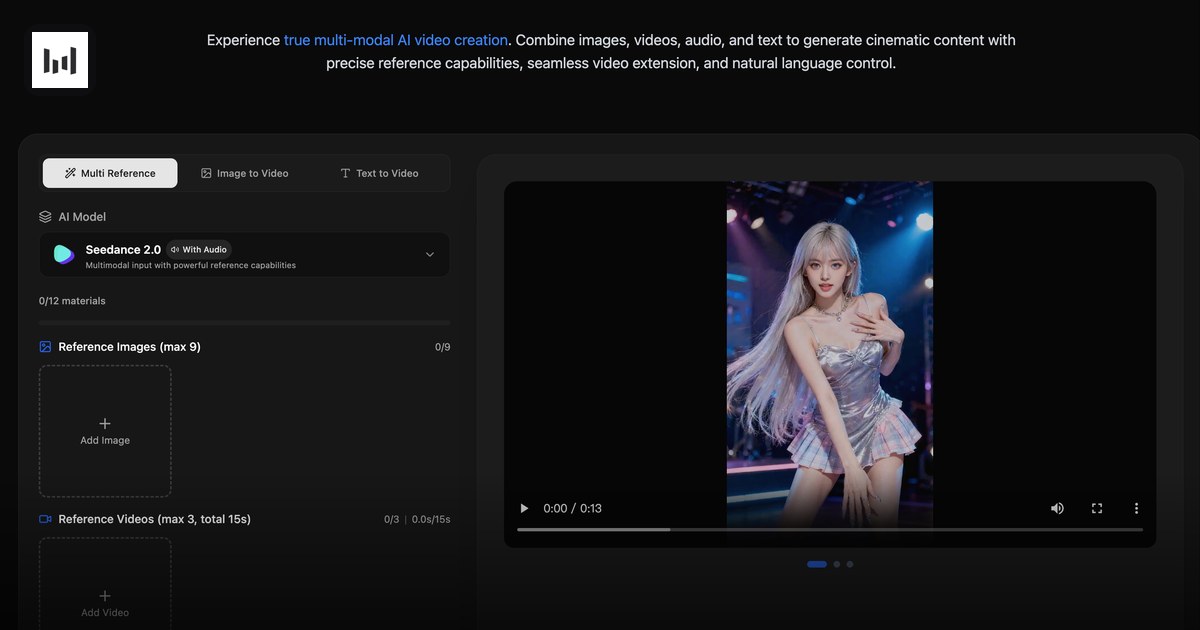
Seedance 2.0 produces high-quality videos with flexible resolution (480p/720p/1080p), an audio toggle, first and last frame conditioning, and support for up to 9 reference images for maximum creative control.
What is ByteDance Seedance 2.0 and how it works?
Seedance 2.0 is ByteDance's latest video generation model, designed for creators who need precise control over their output. With first and last frame conditioning, you can define exactly where a video starts and ends, making it perfect for transition shots, morphing effects, and narrative sequences.
The model supports up to 9 reference images, allowing you to guide style, subject identity, and composition with remarkable fidelity. This multi-reference approach ensures consistency across a series of clips or within a single complex generation.
On Mivo, you can iterate quickly at 480p to validate ideas, then render at 720p or 1080p for final delivery. The audio toggle lets you generate sound in-model or handle audio separately in post-production.
Choose the right Seedance 2.0 mode for your project
Lowest cost at 9 credits/s. Ideal for rapid iteration, prompt testing, and validating framing before committing to higher resolution.
Balanced quality and cost at ~18 credits/s. Great for social media content and web-ready deliverables.
Maximum fidelity at 33 credits/s. Best for final delivery, ads, and high-quality production work.
What makes Seedance 2.0 a game changer
Define both the starting and ending frames of your video to control the narrative arc precisely. Ideal for transition effects and storytelling.
Feed multiple reference images to guide style, composition, and subject consistency across your generation.
Enable or disable native audio generation alongside your video, giving you flexibility for sound design workflows.
Choose 480p for fast iteration, 720p for social-ready content, or 1080p for polished deliverables.
Multi-reference image workflow
The ability to use up to 9 reference images is a game-changer for brand consistency. Upload your brand color palette image, a style reference, a subject photo, and composition guides simultaneously. Seedance 2.0 synthesizes all inputs to produce a video that respects each reference.
For character-driven content, include front, side, and detail reference shots to help the model maintain identity across different angles and lighting conditions. This reduces the need for multiple generations and keeps your output consistent.
First and last frame use cases
First and last frame conditioning opens creative possibilities beyond standard text-to-video. Create morphing transitions between two product shots, animate a still image into a dynamic scene that resolves to a specific composition, or generate before-and-after style content for social media.
For storytelling, set your opening and closing frames to establish narrative bookends. The model fills in the motion between them, ensuring your video starts and ends exactly where you intend.
How to get started with Seedance 2.0 on Mivo
Step 1. Open the Mivo Studio and select Seedance 2.0. Write a clear prompt describing the subject, action, and environment.
Step 2. Upload reference images (up to 9) to guide style and composition, and optionally set first and last frames for transition control.
Step 3. Choose resolution (480p for testing, 720p or 1080p for delivery) and toggle audio on or off based on your workflow.
Step 4. Generate, review the result, and iterate by adjusting one variable at a time. When satisfied, publish to your Mivo profile or download.
Prompt guidance
Lead with the subject and action, then define the environment and lens. If you want a cinematic vibe, mention framing and a single camera move. Adjectives are helpful in small doses - two or three well-chosen words are better than long lists.
Keep each clip focused on one action to reduce ambiguity. For multi-shot stories, reuse a short prompt skeleton and change only the subject or scene. This approach keeps tone and physics consistent across shots.
Use cases and audiences
Seedance 2.0 fits well into content pipelines that demand quality and flexibility. Marketing teams can iterate on product showcases, social media managers can produce platform-ready clips, and narrative creators can build story beats with consistent visual language.
For brand work, the model's ability to maintain framing and motion across retries makes it dependable for deadline-driven work. Education and editorial teams benefit from clear, readable motion for explainers and demonstrations.
Seedance 2.0 vs Veo 3.1: detailed comparison
From Seedance 2.0's perspective: Seedance 2.0 focuses on first and last frame conditioning; Veo 3.1 emphasizes cinematic fidelity and stable composition.
Aspect ratios and duration
Choose 16:9 when you need a widescreen, cinematic presentation or YouTube-first deliverables. Use 1:1 for square placements where center-weighted composition matters. Reserve 9:16 for vertical platforms to maximize screen real estate and subject emphasis.
Durations up to 10 seconds generally balance fidelity and speed. If the narrative requires more time, break the idea into multiple shots and assemble them in post.
Post-production workflow
Export final takes from Mivo and bring them into your editor to add typographic overlays, sound design, and color trims. Because Seedance 2.0 maintains consistent motion, cuts between takes feel natural.
For brand work, lock the look with a short LUT pass and light sharpening rather than heavy grading. Keep titles legible in vertical layouts by testing safe areas early.
Troubleshooting and refinement
If styles drift, simplify wording and prioritize concrete nouns over adjective stacks. When composition feels unstable, specify shot type and a single camera move. If subjects lack clarity, reduce scene complexity and keep one action per take.
Seedance 2.0 responds best to deliberate changes. Modify one parameter at a time - camera, lighting, lens, or action - and compare results side by side. This lets you steer the model toward a repeatable aesthetic without sacrificing production speed.
Why use Mivo AI for Seedance 2.0
Iterate with short drafts, publish to your profile for donations, or download for external editing - no lock-in.
Fast previews and reliable tasks help you validate ideas quickly and keep teams moving.
Purpose-built tips and templates reduce drift and make looks repeatable across a series.
OG images and galleries are served on-domain for strong previews and consistent brand presentation.